
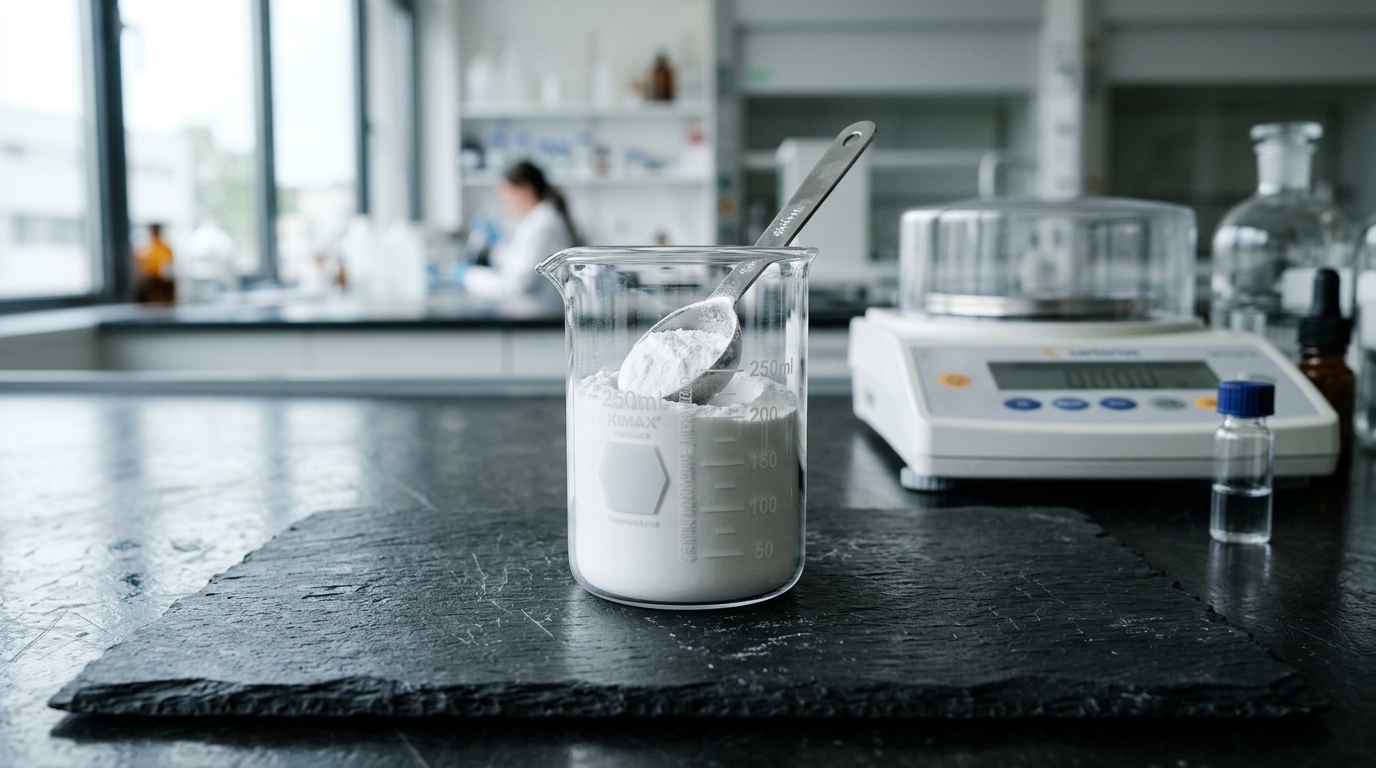
- The Aqueous Solubility Myth: Creatine Hydrochloride (HCL) exhibits ~38-fold greater aqueous solubility in water compared to standard monohydrate. However, once passing through the gastric acidic environment (pH 1.5–2.0) into the small intestine, both forms dissociate completely into identical free creatine ions.
- Cellular Saturation Mechanics: Intracellular muscle and brain phosphocreatine (PCr) stores are determined exclusively by the sodium-dependent creatine transporter (CreaT / SLC6A8). Peer-reviewed trials demonstrate that Creatine HCL does not increase muscle saturation or power output beyond standard micronized monohydrate.
- Clinical Stratification: Micronized Creatine Monohydrate (Creapure®, 3–5g daily) remains the unmatched gold standard for efficacy and cost. Creatine HCL (1.5–2.0g daily) is indicated solely for individuals who experience persistent gastrointestinal distress or bloating from monohydrate.
Few dietary supplements possess the overwhelming volume of peer-reviewed clinical validation enjoyed by creatine. Operating as a fundamental physiological energy buffer, creatine phosphorylates into phosphocreatine (PCr) within skeletal muscle and neural tissue, donating its phosphate group to rapidly regenerate adenosine triphosphate (ATP) via the creatine kinase reaction during high-intensity cellular demands.
Despite this definitive efficacy, supplement marketing has proliferated alternative forms, most notably Creatine Hydrochloride (HCL). Marketed with aggressive claims of “micro-dosing” and superior bioavailability, evaluating Creatine HCL against Creatine Monohydrate requires examining gastrointestinal dissociation kinetics and SLC6A8 transporter saturation.
Pharmacokinetic Matrix: Monohydrate vs. Hydrochloride (HCL)
| Clinical Metric | Micronized Creatine Monohydrate | Creatine Hydrochloride (HCL) |
|---|---|---|
| Molecular Yield (Pure Creatine) | 87.9% (1,000 mg salt = 879 mg active creatine) | 78.2% (1,000 mg salt = 782 mg active creatine) |
| Aqueous Solubility (g/100 mL @ 20°C) | ~1.0 g / 100 mL (Moderate; requires stirring) | ~38.0 g / 100 mL (Extreme; dissolves instantly) |
| Intestinal Transporter Mechanism | SLC6A8 (CreaT) Sodium/Chloride Cotransporter | SLC6A8 (CreaT) Sodium/Chloride Cotransporter |
| Daily Saturation Maintenance Dose | 3.0 – 5.0 g / day (100% saturation maintained) | 1.5 – 2.5 g / day (Sub-optimal without sufficient molecular mass) |
| Gastric Tolerance Profile | Mild distress if consumed without adequate water; excellent if micronized | Superior for sensitive stomachs due to lower required fluid volume |
The SLC6A8 Bottleneck: Why “Micro-Dosing” Fails
Proponents of Creatine HCL assert that because the molecule is dramatically more soluble in water, a consumer only needs to take 750 mg to 1,500 mg daily to achieve the same muscle fullness as 5,000 mg of monohydrate. This claim conflates *in vitro* solubility in a glass with *in vivo* cellular uptake physiology.
When creatine enters the duodenum, it encounters a sodium-dependent transporter known as SLC6A8. This transporter moves free creatine across the plasma membrane against a concentration gradient. Because both monohydrate and HCL dissociate into the exact same free creatine molecule in gastric acid, the SLC6A8 transporter cannot distinguish between them. Muscle saturation requires filling an absolute physical reservoir (~120–140 mmol/kg dry muscle mass). Delivering 1.5 grams of HCL provides only ~1.17 grams of actual creatine—mathematically insufficient to achieve full tissue saturation in a 75–90kg human.
For cognitive function and neural bioenergetics, achieving full systemic saturation is non-negotiable, as detailed in our baseline research on Creatine Monohydrate in 2026: Brain Energy, Cognitive Function & Saturation Protocols.
When Creatine HCL Is Genuinely Clinically Indicated
While the marketing claims of superior muscle uptake are unsupported by clinical trials, Creatine HCL possesses one legitimate clinical application: severe gastrointestinal sensitivity.
Because standard coarse creatine monohydrate has lower solubility in cold water, unabsorbed crystals can remain in the intestinal lumen, creating a localized osmotic draw that pulls water into the bowel, causing cramping or diarrhea in about 5% to 7% of users. For these individuals:
- Switching to 200-mesh Micronized Monohydrate (Creapure®) dissolved in warm liquid generally resolves the issue completely.
- If distress persists, Creatine HCL (2.5g daily) completely eliminates undissolved crystalline matter due to its low pH and high solubility, restoring gastric comfort.
When stacking creatine for cellular energy, combining it with mitochondrial electron transport cofactors like CoQ10 maximizes cellular ATP output, as explored in CoQ10 Ubiquinone vs. Ubiquinol: The Mitochondrial Bioenergetics Guide.
Frequently Asked Questions (Clinical PAA Direct Answers)
Creatine supplementation naturally increases baseline serum *creatinine* because creatinine is the metabolic breakdown byproduct of phosphocreatine. This is a benign, non-pathological lab artifact, not renal damage. To accurately assess kidney filtration in individuals taking creatine, physicians order a Cystatin-C blood test, which is unaffected by supplemental creatine or muscle mass.
No. Loading (20g/day split into 4 doses for 5–7 days) saturates intramuscular PCr stores in 7 days. However, consuming a steady maintenance dose of 3–5g daily achieves identical intracellular saturation within 21 to 28 days with zero risk of gastrointestinal distress or acute water shifts.
No. Creatine draws water into the *intracellular* compartment (inside the muscle cells via cellular osmolyte dynamics), which enhances protein synthesis and cell volume. It does not cause subcutaneous “bloating” unless an under-dosed protocol fails to saturate muscle cells properly.
For 95% of healthy adults and athletes, Micronized Creatine Monohydrate (Creapure®, 5 grams daily) remains the definitive, evidence-based choice. It delivers 88% elemental yield, costs a fraction of designer analogs, and is validated by hundreds of clinical trials. Reserve Creatine HCL strictly as a specialized problem-solver for the minority of patients with genuine gastrointestinal intolerance to monohydrate.