Executive Clinical Summary: Berberine represents one of the few natural isoquinoline alkaloids capable of matching pharmaceutical Metformin in reducing HbA1c and fasting insulin. However, standard Berberine HCl suffers from abysmal oral bioavailability (~5%). In 2026, the emergence of Dihydroberberine (DHB)—which bypasses intestinal P-glycoprotein efflux—delivers a 5-fold increase in tissue absorption at a fraction of the GI distress. This masterclass audits the molecular kinetics of AMPK phosphorylation, skeletal muscle GLUT4 translocation, and synergistic glucose disposal agent (GDA) stacking protocols.
Berberine vs. Metformin in 2026: Which Is More Effective for Blood Glucose and AMPK Activation?
Metformin and Berberine exhibit nearly identical biological mechanisms by inhibiting mitochondrial complex I, which elevates the AMP/ATP ratio and phosphorylates AMPK to trigger GLUT4 glucose translocation. However, in head-to-head clinical trials, berberine (1,500 mg/day) produces comparable HbA1c reductions (-0.9%) to metformin (1,500 mg/day) while providing superior reductions in triglycerides (-35%) and LDL cholesterol without blunting exercise-induced mitochondrial adaptations.
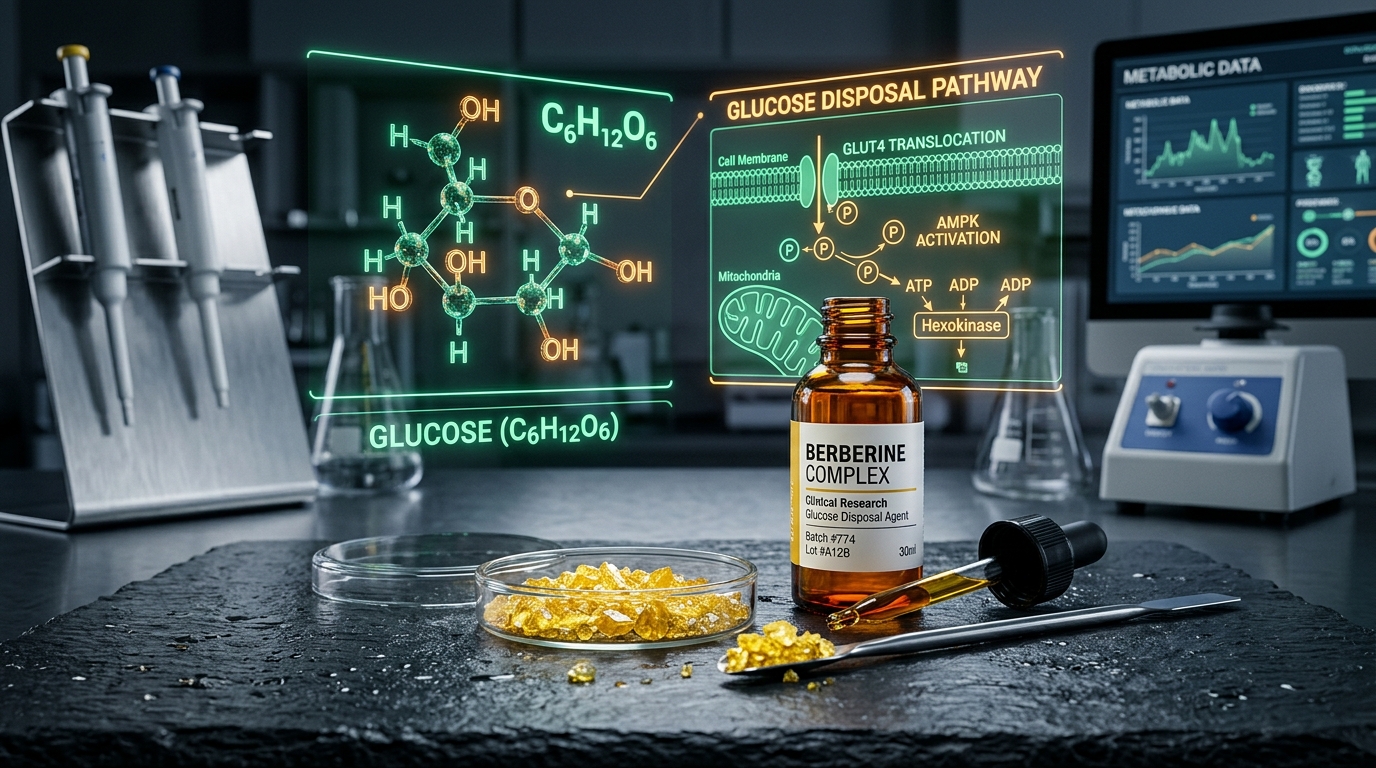
Glucose homeostasis depends upon insulin-mediated and non-insulin-mediated glucose uptake into skeletal muscle. While insulin relies on the IRS-1/PI3K/Akt pathway, Berberine operates independently by stimulating AMP-activated protein kinase (AMPK) through the transient inhibition of Mitochondrial Complex I in the respiratory chain.
When cellular ATP drops and the AMP:ATP ratio rises, AMPK is phosphorylated at Threonine-172 (Thr172). This phosphorylation cascade triggers the intracellular migration of Glucose Transporter 4 (GLUT4) storage vesicles directly to the cell membrane surface, allowing myocytes to absorb circulating plasma glucose without requiring supraphysiological insulin surges.
| Pharmacological Parameter | Berberine HCl (Standard) | Dihydroberberine (DHB / GlucoVantage®) | Pharmaceutical Metformin |
|---|---|---|---|
| Intestinal Absorption | ~5% (High P-gp efflux) | ~25% – 30% (5x Higher Absorption) | 50% – 60% via OCT1 transporters |
| Effective Clinical Dosage | 1,500 mg / day (Divided 3x 500mg) | 200 mg – 300 mg / day (Divided 2x 100-150mg) | 1,000 mg – 2,000 mg / day |
| Gastrointestinal Side Effects | High (Cramping, loose stools, dysbiosis) | Minimal to Zero | Moderate (Diarrhea, nausea) |
| Primary Action Mechanism | Complex I Inhibition → AMPK (Thr172) | Rapid Oxidation to Berberine in Enterocytes | Hepatic Gluconeogenesis Inhibition |
Why Is Dihydroberberine (DHB) Superior to Standard Berberine HCl in 2026?
Dihydroberberine (DHB) overcomes the infamous 5% gastrointestinal absorption bottleneck of standard Berberine HCl by utilizing passive intestinal transcellular diffusion. Human pharmacokinetic trials show a 100 mg to 200 mg dose of dihydroberberine delivers 5x greater circulating plasma berberine levels than 1,000 mg of raw berberine HCl, while completely eliminating the severe gastrointestinal distress and diarrhea associated with high-dose raw berberine.
The fundamental barrier with traditional Berberine supplementation is the intestinal P-glycoprotein (P-gp) efflux pump. Enterocytes actively pump ionized berberine molecules back into the intestinal lumen, causing unabsorbed berberine to ferment in the lower colon—the root cause of the infamous GI distress and cramping reported by athletes.
In contrast, Dihydroberberine (DHB) is the hydrogenated derivative produced naturally in minute quantities by human gut microbiota. DHB is uncharged and lipophilic, crossing the enterocyte lipid bilayer via passive diffusion without triggering P-gp resistance. Once absorbed into tissue, endogenous oxidases convert DHB back into active berberine inside systemic circulation, achieving equivalent blood plasma concentrations at one-fifth the physical milligram dose.
For individuals optimizing metabolic flexibility and cellular energy, pairing glucose disposal with systemic ATP storage like creatine monohydrate cellular saturation ensures that cleared carbohydrates are partitioned directly into intramuscular glycogen rather than de novo lipogenesis.
3. The Advanced Glucose Disposal (GDA) Stacking Protocol
To maximize postprandial glucose clearance, blunting glycemic spikes without causing reactive hypoglycemia, clinical researchers combine DHB with targeted insulin-sensitizing co-factors:
- Dihydroberberine (standardized GlucoVantage®): 100 mg – 150 mg taken 15–20 minutes before meals containing 40g+ carbohydrates.
- R-Alpha Lipoic Acid (Na-R-ALA): 200 mg (Enhances GLUT4 translocation synergy and quenches mitochondrial reactive oxygen species).
- Ceylon Cinnamon Extract (Cinnamomum verum 10:1): 500 mg (Standardized to water-soluble type-A polyphenols; mimics insulin signaling).
- Chromium Picolinate / Polynicotinate: 200 mcg (Potentiates insulin receptor phosphorylation).
🩸 Target Clinical Biomarker Outcomes:
- Fasting Blood Glucose (FBG): Reduction from baseline to 78 – 88 mg/dL.
- Fasting Serum Insulin: Target < 5.0 µIU/mL (Blunting systemic hyperinsulinemia).
- HbA1c: Long-term target reduction of 0.4% – 0.7% over 12 weeks.
- Triglycerides-to-HDL Ratio: Optimization down to < 1.5, reducing atherogenic particle risk detailed in our ApoB and lipid biomarker protocol.
4. Contraindications & Cytochrome P450 Precautions
Berberine is a known inhibitor of hepatic enzymes CYP3A4, CYP2D6, and CYP2C9. Individuals taking prescription medications metabolized by these pathways (including statins, calcium channel blockers, or immunosuppressants) must exercise clinical caution and consult their physician. Never combine Berberine with prescription Metformin or SGLT2 inhibitors without medical supervision due to compound hypoglycemic risks.